
Overview
In a couture garment, a finely made backpack, or a piece of high-performance outdoor gear, the zipper is a small component—yet it often defines the first impression and the final user experience.
A premium zipper helps a product age well; a single jam, slippage, or discoloration can be enough to damage brand trust.
How to Choose High-Quality Zippers? This guide walks you through the complete set of “good zipper” criteria—from materials, processes, and quality control to supply chain capability, sustainability compliance, and supplier evaluation.
Whether you are a sourcing manager, designer, or manufacturing engineer, you’ll be able to judge one key question after reading:
Is this zipper manufacturer truly worth trusting?
1. Introduction: Why Zipper Quality Determines Product Quality
1.1 The Role of Zippers in Apparel and Bags
Although compact, a zipper is an essential functional and structural component in apparel and bags. It affects the user experience and durability, and it also influences a brand’s perceived quality and design language.
In apparel, zippers are widely used in jackets, jeans, hoodies, sportswear, and more—requiring smooth operation, durability, and visual harmony. In bags, footwear, tents, and other outdoor equipment, zippers oftenassume sealing, water resistance, dust resistance, and anti-burst performance, making them a key contributor to overall functional stability.
A high-quality zipper delivers more than a “smooth feel”—it contributes to reliability, comfort, and brand confidence. Consumers rarely notice the zipper brand, but when a zipper fails, it quickly becomes a negative impression of the entire product. As the industry often says:
“A zipper can make—or ruin—an item of clothing.”

1.2 Common Zipper Quality Problems
In manufacturing, a zipper is a high-frequency mechanical component. Small defects in design, material, or process can cause serious functional failures. Below are typical issues and root causes:
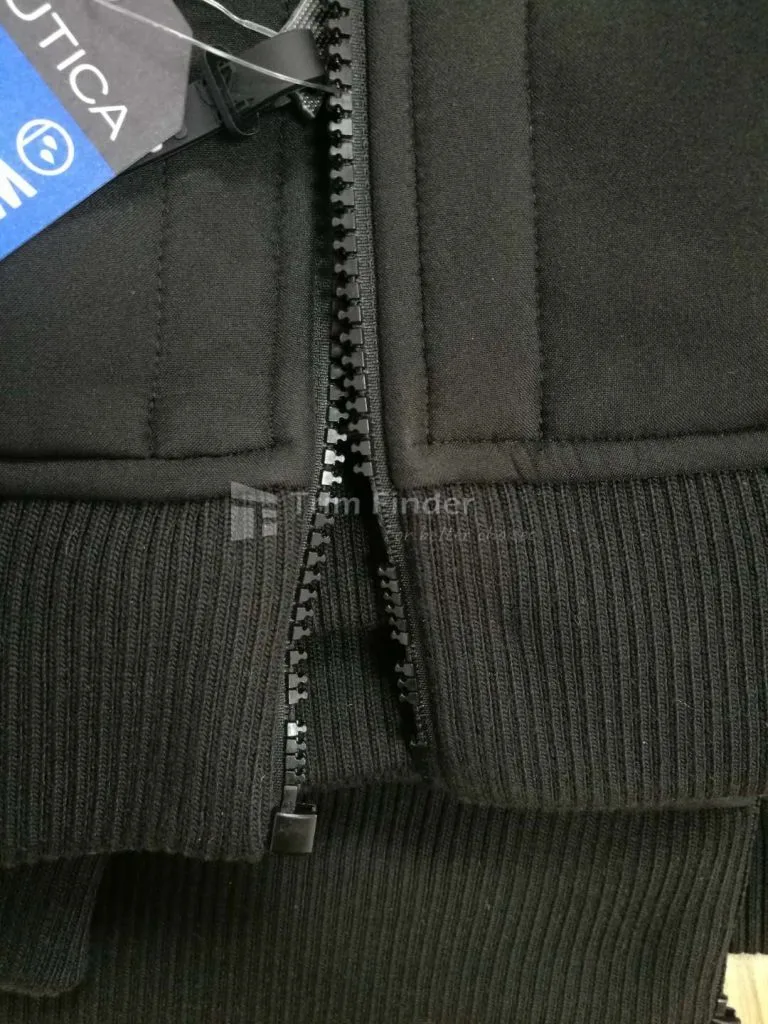
- Slippage (Zipper Slippage): the slider creeps open after closing and the chain separates. Typical causes include a loose locking mechanism, excessive pitch deviation, or insufficient tape tension. Impact: unstable openings in garments or bags, affecting safety and experience.
- Broken teeth (Broken Teeth): metal or resin elements crack or break off. Typical causes include insufficient material hardness, poor tooling, or uneven load. Impact: the zipper cannot close properly, leading to product scrap.
- Jamming (Jamming): the slider feels rough, stalls, or jams. Typical causes include misaligned elements, incorrect slider dimensions, or wrinkled tape. Impact: poor user experience or inability to open/close.
- Rust / discoloration (Rust / Discoloration): oxidation, tarnish, or coating peel on metal parts. Typical causes include inadequate plating and insufficient anti-corrosion treatment. Impact: aesthetic downgrade and potential staining of fabric.
- Tape/chain detachment (Tape or Chain Detachment): the element chain separates from the tape. Typical causes include insufficient bonding strength, incorrect heat-press temperature/pressure, or poor process control. Impact: structural failure and scrap.
1.3 The Economic and Brand Value of Choosing a High-Quality Supplier
Choosing a high-quality zipper supplier is not just a purchasing decision—it is a strategic choice that shapes brand value and supply chain resilience. It matters in three ways:
(1) Lower total cost
Premium zippers may cost slightly more per unit, but stable performance and lower repair/return rates reduce after-sales cost, return risk, and production downtime. In mass production, one zipper issue can trigger rework of an entire lot—losses that far exceed the trim cost.
(2) Better user experience and brand image
A smooth pull, precise locking, and coordinated appearance directly enhance consumers’ perception of “attention to detail.” Many global brands build a subconscious sense of premium craftsmanship through zipper quality.
(3) Stable supply chain and innovation support
Strong suppliers typically have end-to-end capabilities—R&D, tooling, in-house manufacturing—enabling customization such as water-resistant, flame-retardant, or lightweight zippers. With mature lead-time control and batch consistency, they fit fast-response manufacturing and flexible production.
2. Zipper Basics: Types, Structures, and Terminology
2.1 Major Zipper Types
1. Coil Zipper (Nylon/Polyester Coil)
Coil zippers are the most widely used type. The chain is formed by winding polyester/nylon monofilament into a coil and stitching or heat-pressing it onto the tape.
Key features:
• Soft hand feel, lightweight, and smooth—compatible with many fabrics.
• High tensile strength and low risk of broken teeth.
• Can be made water-resistant via film lamination or coating.
• Excellent dyeability with broad color options—ideal for fashion products.
Typical applications:
Sportswear, down jackets, casual jackets, tents, sleeping bags, and luggage interiors.
Common issues & control points:
Coil density and heat-setting temperature directly affect smoothness. Coil rebound must be controlled to avoid “wavy chain” deformation.
2. Metal Zipper (Metal Elements)
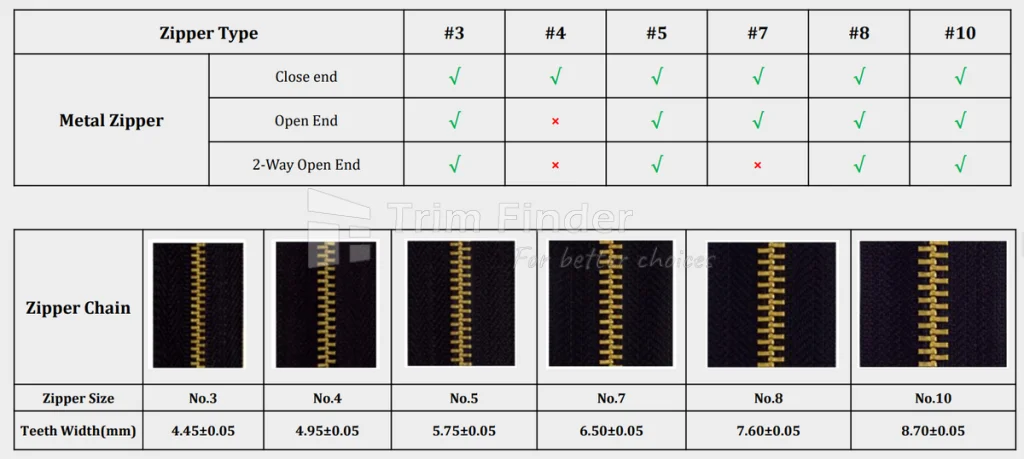
Metal zippers are traditional and highly tactile. Elements are typically stamped/cast from brass, aluminum, or nickel alloys and crimped onto the tape.
Key features:
• Strong, premium look with pronounced texture.
• High mechanical strength and wear resistance.
• Suitable for heavy fabrics and rigid constructions.
• Multiple finishes via electroplating or coating (e.g., gunmetal, antique brass, bright silver).
Typical applications:
Jeans, leather jackets, leather goods, boots, military and outdoor gear.
Common issues & control points:
Element pitch must be precisely matched—too tight or too loose can cause jamming. Plating and corrosion protection must be tightly controlled to prevent oxidation and discoloration.
3. Plastic Molded Zipper (Molded / Resin Zipper)
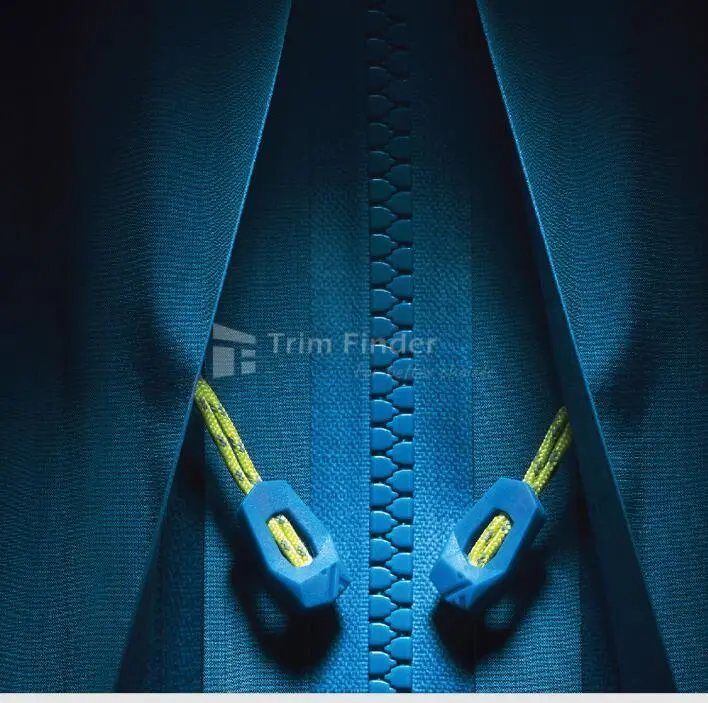
Plastic molded (resin) zippers use POM or other engineering plastics. Elements are injection-molded directly onto the tape.
Key features:
• Strong 3D appearance, lightweight, and corrosion resistant.
• Large-tooth designs with strong visual impact.
• Naturally rust-free; can support certain water-resistant constructions.
• Broad color options, including translucent effects.
Typical applications:
Kidswear, ski wear, backpacks, luggage, and outdoor goods.
Common issues & control points:
Injection temperature and mold precision determine element engagement and smoothness. Large dimensional tolerances may cause jamming or tooth breakage.
4. Invisible Zipper
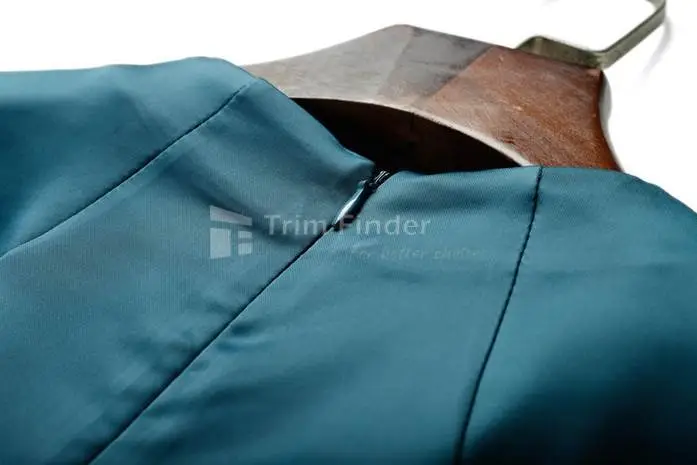
Invisible zippers hide the teeth on the underside of the tape, leaving only the pull visible from the front.
Key features:
• Clean, flat appearance for “no-seam” design.
• Fine coil chain with gentle sliding feel.
• Higher sewing/process requirements.
Typical applications:
Dresses, gowns, pillow covers, curtains, and other products requiring a flat visual finish.
Common issues & control points:
Sewing position deviation can cause puckering or jamming. The slider must match the chain specification to prevent slippage.
2.2 Key Components and Terms
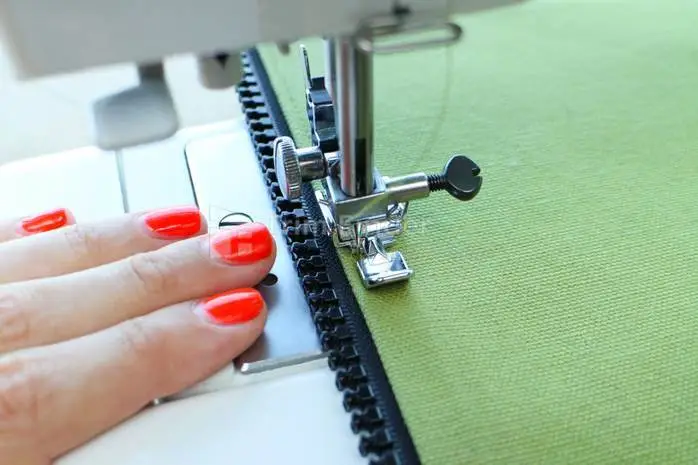
1. Zipper Tape
The tape is the load-bearing base, typically woven polyester or cotton, used to hold the chain and to be sewn into the product. It affects tensile strength, flexibility, and sewing stability.
Key points:
• Weave density and tension control determine tensile strength and dimensional stability.
• Dyeing quality determines colorfastness and shade match with the fabric.
• High-quality tape should be firm yet flexible, wrinkle-resistant, and color-stable.
2. Elements / Teeth
Elements are the functional structure that enables closing and opening. When interlocked, they form a continuous closure line. Depending on material, elements can be metal, molded plastic, or coil.
Key points:
• Pitch accuracy strongly affects smoothness and anti-jam performance.
• Engagement angle and depth define tensile performance and anti-slippage capability.
• Metal and molded elements require polishing, plating, or surface treatment for appearance and corrosion resistance.
• Coil chains require uniform winding and stable heat-setting without rebound.
3. Slider
The slider controls opening and closing. It typically consists of a pull tab, slider body, and a locking mechanism (if applicable). Moving the slider engages or disengages the chain.
Key points:
• The internal cavity must match the chain size precisely—otherwise slippage or jamming occurs.
• Locking type (auto-lock / semi-lock / non-lock) determines whether the zipper can self-hold.
• Plating/coating quality affects abrasion resistance and corrosion performance.
• Premium sliders are often zinc-alloy die-cast for higher precision and durability.
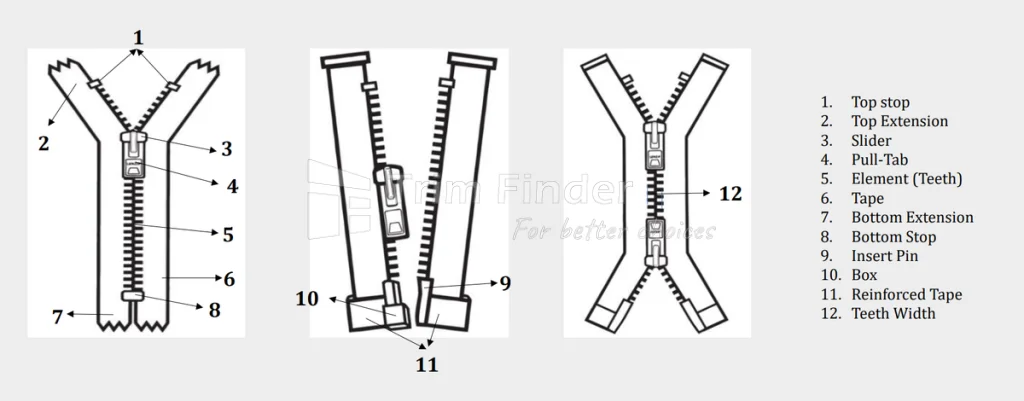
4. Stops (Top Stop / Bottom Stop) and Pin & Box
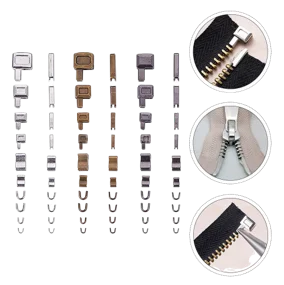
Stops are the end fixtures that prevent the slider from running off the chain. They include top stops and bottom stops.
Key points:
• Top stop: at the top end, prevents the slider from pulling off.
• Bottom stop: at the bottom end, prevents the slider from sliding off.
• For open-end zippers, a pin & box (insertion pin and retainer box) replaces the bottom stop to allow full separation.
• Stops must be firmly attached and precisely positioned; otherwise, they can shift or fall off under load.
2.3 Application Scenarios and Selection Guidance
Apparel (Fashion / Sports / Denim / Gowns / Kidswear)
Typical selection
• Jackets / sportswear: coil zipper (#5/#8), auto-lock; optional reverse coil and waterproof film.
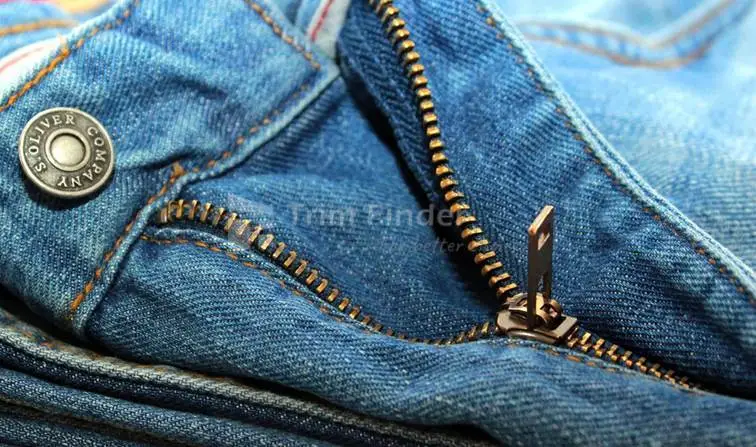
• Jeans: metal zipper (#3/#4.5), semi-lock or auto-lock; corrosion-resistant plating (gunmetal/antique brass).
• Gowns / skirts: invisible zipper (#3), non-lock or invisible-specific slider.
• Kidswear: coil zipper (#3/#5) with larger pull for pinch protection; add a fabric guard at the ends.
Key parameters
• Slider: auto-lock is recommended to prevent unintended opening; for women’s skirts a non-lock may be used but sewing stability is critical.
• Color: tape shade matched to fabric; colorfastness ≥ Grade 4 (perspiration/wash).
• Feel: smooth but not “loose”; slider-cavity vs. pitch match is the core.
Validation & testing
• Cycle test: ≥1,000–5,000 cycles (higher for sports categories).
• Wash/dry-clean colorfastness: ≥ Grade 4; for premium fabrics add color migration tests.
• Salt spray (metal parts): 48–96 hours for mid/high-end products.
Common risks
• Denim jamming on thick fabric: add a fly shield and use reverse/polished elements.
• Down leakage in down jackets: use fine elements and reverse coil; control stitch density.
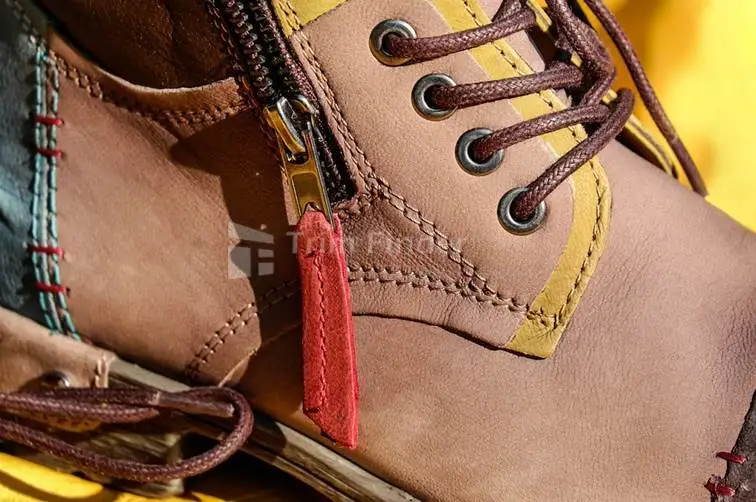
Footwear & Headwear
Typical selection
• Boots / work boots: metal or large-tooth molded POM (#5/#8) with strong lock and sand guard.
• Shoe covers / protective gear: coil zipper (#3/#5) with waterproof film or laminated tape.
• Headwear pockets (hoodie / cap pockets): invisible or fine-tooth coil (#3).
Key parameters
• Flex resistance: the ankle area bends sharply; prioritize coil or polished rounded metal.
• Mud/sand protection: add a dust/rain flap; polish elements to reduce jamming.
Validation & testing
• Low-temperature flex: repeated bending at −20°C without cracking.
• Sand/jam simulation: functional retention ≥95% after particulate cycling.
Common risks
• High-tension points causing broken teeth: reinforce bottom stop, widen seam allowance, or use thicker tape.
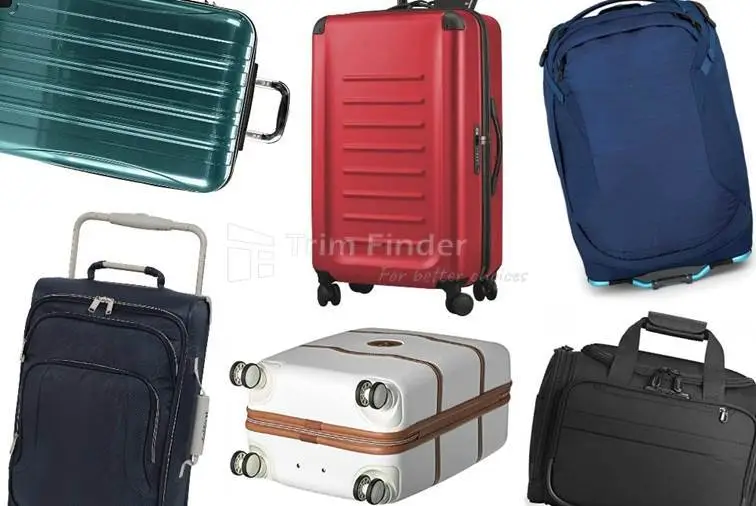
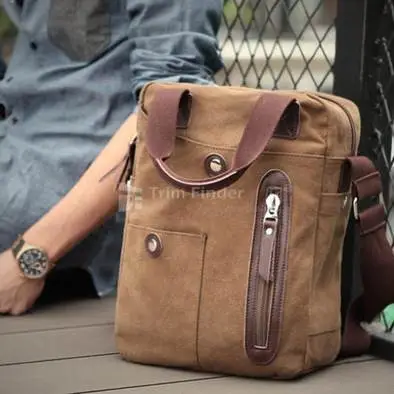
Bags & Luggage (Backpacks / Carry-ons / Laptop Bags / Camera Bags)
Typical selection
• Backpacks/laptop bags: coil zipper (#5/#8), two-way sliders; optional self-repair structure.
• Luggage: large-tooth molded or metal (#8/#10) with anti-burst design and thicker tape; compatible with TSA lock systems.
• Camera/tool bags: waterproof coil or laminated tape (#5/#8) with large pull tabs for easy grip.
Key parameters
• Anti-burst: prioritize reverse coil/high engagement depth coil or large-tooth molded types.
• Anti-cut protection: if using cut-resistant fabric, consider hidden tracks and narrow channels.
• Water resistance: PU/TPU laminated tape plus seam sealing; use water-resistant slider designs.
Validation & testing
• Loaded cycling: 500–1,000 cycles under rated load without chain separation.
• Salt spray / perspiration: ≥72 hours for island/travel products.
• Pull-tab tensile: ≥150–300 N.
Common risks
• Two-way synchronization issues: ensure consistent engagement and accurate limits.
• Corner jamming: corner radius ≥ 3× tooth width; prefer softer tape base.
Military & Tactical Gear (Vests / Tactical Packs / Holsters)
Typical selection
• High-strength: metal or high-strength molded POM (#8/#10), military colors (Coyote, OD Green), matte low-reflective finishes.
• Fast operation: oversized pull tabs + cord loops for gloved use; auto-lock or strong spring locking.
Key parameters
• Low-visibility and corrosion resistance: matte plating/anodized color; salt spray ≥96–168 hours.
• Sand/dust resistance: tight engagement; add flaps or coated chains.
Validation & testing
• Extreme climate: −30 to +60°C cycles; dust/sand endurance ≥2,000 cycles.
• Salt spray: ≥120 hours; tensile: ≥300–500 N depending on the area.
Common risks
• Field sand jamming: use reverse coil with tighter engagement plus a protective flap.
• Night reflections: avoid bright plating and reflective metal logos.
Outdoor Products (Tents / Sleeping Bags / Shell Jackets / Wetsuits)
Typical selection
• Tents: coil or molded (#8/#10), long two-way; UV-resistant; sand/dust tolerant.
• Sleeping bags: coil (#5/#8) with anti-snag tape and glow pull for night use.
• Shell/rain jackets: waterproof coil (laminated or injected), #5/#8, water-resistant slider.
• Wetsuits/water sports: waterproof/sealed constructions; corrosion-resistant hardware or metal-free solutions.
Key parameters
• Waterproof level: with laminated tape and seam sealing, hydrostatic head ≥5,000–10,000 mm (per garment standard).
• Low-temperature smoothness: no brittleness at −20°C; long zippers require anti-waving control.
• Long-chain waviness: control heat-setting and tape tension; use guide sliders.
Validation & testing
• UV aging: equivalent 24–48 hours; salt spray: 96–240 hours for marine products.
• Cycle test: ≥3,000 cycles for long zippers; post-immersion retention ≥95%.
Common risks
• Waterproof failure: the zipper is only one part of the system—validate together with flap and seam sealing.
• Long-chain waviness: improve heat-setting and tension control; consider guiding slider structures.
Quick Reference Table (for fast selection)
| Scenario | Recommended Type | Common Size | Key Features | Must-Test Items |
| Jackets / Sportswear | Coil / Waterproof coil | #5 / #8 | Smooth; optional waterproof | Cycle test; washing; colorfastness |
| Jeans | Metal | #3 / #4.5 | Strong lock; wear resistant | Salt spray; plating adhesion; pull strength |
| Gowns / Skirts | Invisible | #3 | Flat; lightweight | Sewing strength; smoothness |
| Backpacks / Luggage | Coil / large-tooth molded | #5 / #8 / #10 | Anti-burst; two-way | Loaded cycling; salt spray; pull strength |
| Military / Tactical | Metal / molded | #8 / #10 | Sand resistant; corrosion resistant; low-reflective | Extreme climate; salt spray; tensile strength |
| Outdoor gear | Waterproof coil / molded | #5 / #8 / #10 | Water-resistant; weatherproof | UV; function after immersion |
3. How to Evaluate Zipper Quality (Product-Level Criteria)
3.1 Materials and Manufacturing Processes
I. Material Differences and Performance
1. Nylon Monofilament (for Coil Zippers)
Coil elements are formed by winding high-strength nylon monofilament and fixing it to the tape through heat-setting.
Performance characteristics:
• Excellent flexibility: ideal for lightweight fabrics; better bending performance than metal.
• High tensile strength: withstands repeated open/close cycles without breaking.
• Good corrosion resistance: no rusting; low risk of moisture discoloration.
• Strong customization: dyeing and lamination enable many colors and water-resistant variants.
Key control points:
• Monofilament diameter and winding density must be consistent—otherwise “wavy chain” can occur.
• Heat-setting is typically 180–200°C; excessive temperature can cause melting, collapse, or embrittlement.
2. Cu–Zn Alloy (Brass) for Metal Zippers
Metal zippers commonly use brass (copper–zinc alloy), which offers good mechanical properties and plating compatibility.
Performance characteristics:
• High strength and wear resistance: suitable for heavy-duty use (jeans, leather jackets, luggage).
• Premium appearance: supports multiple plating options (nickel, antique brass, gunmetal, gold, etc.).
• Thermal stability: less prone to deformation during high-temperature washing/ironing.
Key control points:
• Copper content typically should be ~65–70%; too low reduces toughness and can increase tooth breakage.
• Elements must be deburred and polished to ensure smooth operation.
• Plating thickness should typically be ≥0.2 μm with strong adhesion to prevent peeling.
3. POM Resin (Polyoxymethylene) for Molded Zippers
Molded zippers often use POM, a high-strength engineering plastic used for molded elements and some slider components.
Performance characteristics:
• High strength and fatigue resistance: suitable for large-tooth structures.
• Good chemical resistance: stable in humid or mildly acidic/alkaline environments.
• Lightweight advantage: lighter than metal—useful in outdoor and kids products.
Key control points:
• Injection temperature is typically 180–220°C; fluctuations can cause shrinkage or deformation.
• Mold precision directly determines engagement smoothness.
• Add UV stabilizers and antioxidants to prevent aging and whitening.
II. Surface Finishes and Functional Treatments
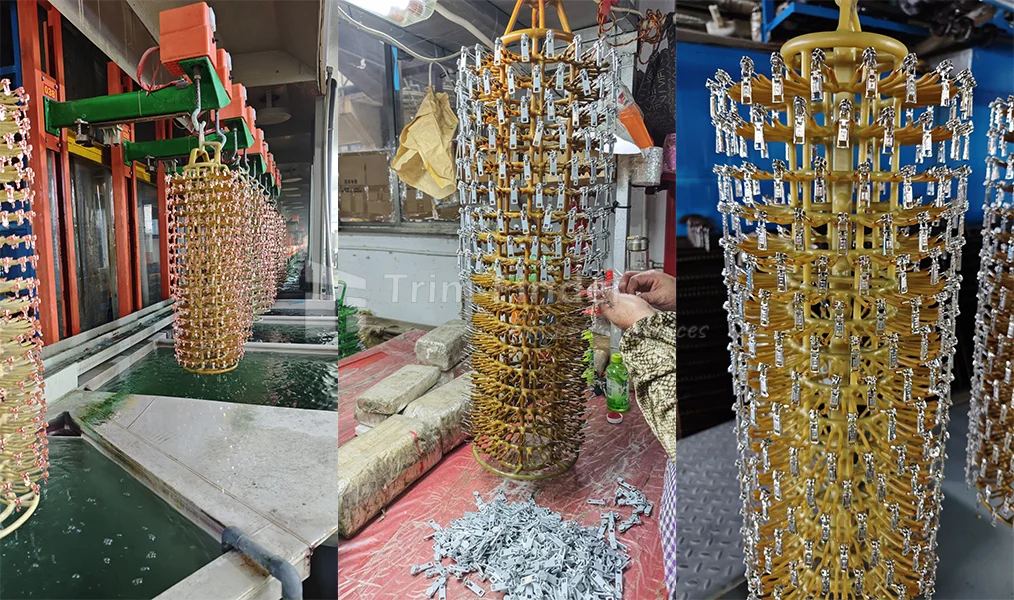
1. Electroplating
Applicable to metal elements and many metal sliders.
Purpose: improve corrosion resistance and appearance.
Common finishes: nickel, antique brass, black nickel, gunmetal, gold.
Key metrics: thickness, adhesion, salt-spray duration.
For high-end brands, salt-spray performance of metal parts is often ≥96 hours without visible rust spots.
2. Coating / Painting
Often used on sliders and for coloration of molded parts.
Advantages: vivid colors; matte or gloss finishes.
Risks: poor adhesion causes peeling; surface degreasing is required before coating.
3. Anti-corrosion Treatment
Typical methods: plating sealers, nano anti-rust films, protective oil films.
Requirement: should not degrade plating gloss or sliding feel.
4. Colorfastness Treatment
After tape dyeing, fixation and high-temperature setting are required.
Before garment production, verify resistance to detergents, perspiration, and UV exposure.
III. Practical Checklist (Summary)
| Item | Material Type | Key Checks | Typical Tests |
| Zipper tape | Nylon / Polyester | Weave density, stiffness, colorfastness | Tensile test; abrasion test |
| Elements/chain | Metal / Coil / Molded | Engagement accuracy; strength | Cycle test; tensile strength |
| Slider | Zinc alloy / POM | Locking performance; wear resistance | Cycle count; salt spray |
| Surface finish | Plating / Coating | Adhesion; corrosion resistance | Salt spray; dry/wet rub |
3.2 Precision and “Feel”
I. Tooth Pitch & Alignment
Tooth pitch and alignment refer to the spacing between elements and the symmetry of the two sides. Uneven pitch or excessive deviation leads to poor engagement and jamming.
Typical technical targets:
• Metal/molded pitch tolerance: within ±0.03 mm.
• Coil zippers: coil spacing deviation ≤ ±0.5%.
• Left/right symmetry and centerline shift ≤ 0.2 mm.
Inspection methods:
• Optical projector measurement for pitch deviation.
• Engagement strength testing for stability.
Performance cues:
High precision → tight engagement and smooth feel.
Low precision → jamming, looseness, or slippage.
II. Smoothness
Smoothness is one of the most user-visible indicators. It reflects element machining accuracy, slider design, and friction control.
Key drivers:
• Element surface roughness: Ra ≤ 0.8 μm (polish metal; stable heat-setting for coil).
• Slider cavity finish: no burrs or dents.
• Lubrication: premium zippers may use wax treatment or nano-lubricant coatings to reduce friction.
Test method:
Use a cycling machine for 500 open/close cycles; smoothness should remain consistent without stalling.
Judgment:
Premium: smooth pull, no vibration, holds position without creeping.
Poor: noticeable notchiness, noise, or loosening/slippage.
III. Slider Locking Performance
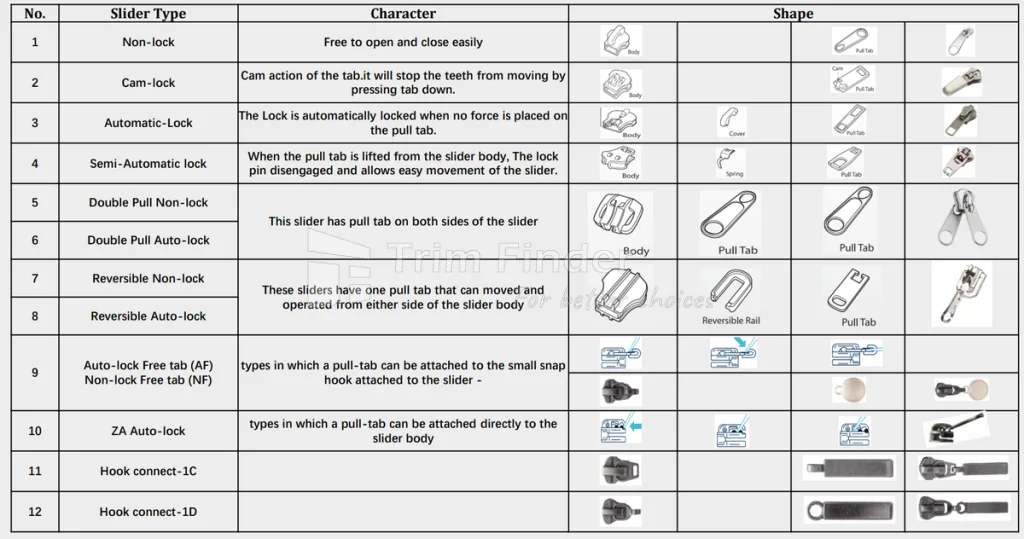
The locking mechanism prevents the slider from creeping open. Common designs: auto-lock, semi-lock, and non-lock.
Technical points:
• Auto-lock uses a spring pin to bite into the elements, maintaining closure under load.
• Semi-lock is triggered by pull-tab angle.
• Non-lock is for decorative/light-duty use (e.g., many invisible zippers).
Typical performance targets:
• Lock holding force: ≥1.5 kgf (apparel) / ≥3 kgf (bags).
• Pull force to start movement: ≤2.0 N for easy operation.
Test methods:
• Apply vertical load with a tensile tester and check for creep at a defined length.
• Check holding performance under vibration.
3.3 Reliability Testing
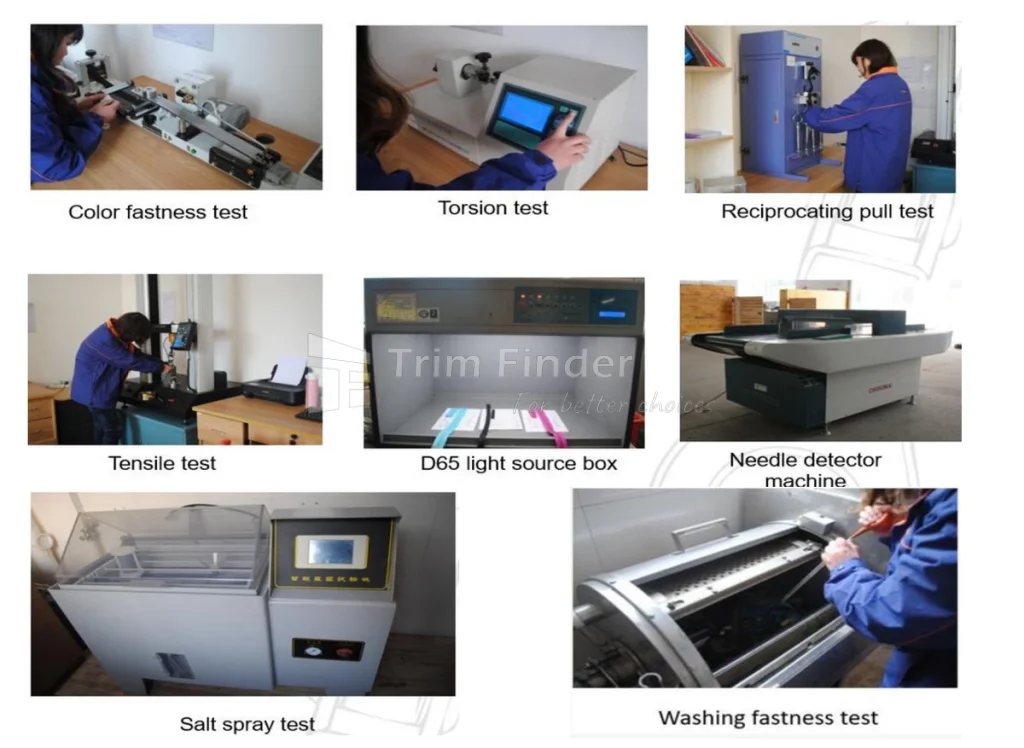
Reliability testing verifies zipper stability and durability under real use and environmental conditions. It is also a key part of major brands’ supplier audits.
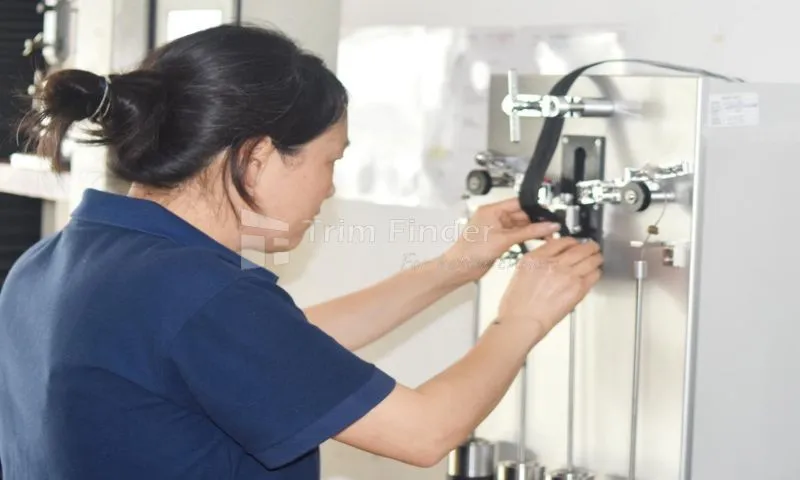
I. Tensile Strength Test
Purpose: verify overall load capacity and engagement strength.
Method:
Apply longitudinal tensile force and record the break/separation point; also test pull-tab attachment strength.
Typical references: ASTM D2061 / ISO 13934.
Minimum tensile strength (example reference):
| Zipper Type | Typical Size | Minimum Tensile Strength |
| Coil zipper | #5 | ≥ 150 N |
| Metal zipper | #5 | ≥ 180 N |
| Molded zipper | #8 | ≥ 200 N |
II. Wash Resistance Test
Purpose: verify color change, deformation, or performance loss after washing/dry-cleaning/drying.
Typical conditions:
• 40–60°C cyclic washing for ≥20 cycles.
• Detergents and abrasion media included.
• Compare before/after color, smoothness, and engagement strength.
Acceptance examples:
• Color difference ΔE ≤ 1.0.
• No obvious change in feel.
• No cracking or deformation of elements.
III. Thermal Resistance Test
Purpose: evaluate performance stability in high/low temperature environments.
Method:
Hold at −30°C and +70°C for 24 hours; perform 10 hot/cold cycles, then check smoothness and structural changes.
Acceptance cues:
• Coil/molded elements do not crack or warp.
• Metal elements do not jam from thermal expansion.
• Slider coating does not peel.
IV. Salt Spray Test
Purpose: assess corrosion resistance of metal parts, especially metal elements and plated sliders.
Typical conditions (ASTM B117):
• 5% NaCl mist at 35°C.
• Duration: 48h / 96h / 168h (per customer standard).
Acceptance:
• No visible rust, discoloration, or coating delamination.
• Sliding function remains unaffected.
3.4 Sustainability and Certifications
In global apparel and bag supply chains, environmental and compliance requirements for zippers—components that contact fabrics and sometimes skin—are increasingly strict. A high-quality zipper must not only perform well, but also comply with international chemical restrictions and management system requirements.
I. Environmental Regulations and Chemical Restrictions
1. OEKO‑TEX® Standard 100
OEKO‑TEX is one of the most widely recognized standards for harmful substances in textiles and trims. It tests for a broad set of chemicals to ensure products are safe for human use.
Key test categories include:
• Heavy metals (lead, cadmium, mercury, chromium)
• Formaldehyde; phthalates
• Azo dyes and releasable aromatic amines
• Organotin compounds; PAHs, etc.
Scope:
All parts that may contact skin or fabric—tape, thread, elements, plating, dyes and auxiliaries.
Value:
With OEKO‑TEX certification, zipper materials and processes meet human-ecology safety criteria and can be used for baby/kidswear and close-to-skin products.
2. REACH (EU Regulation)
REACH (Registration, Evaluation, Authorization and Restriction of Chemicals) is the EU chemical control regulation applicable to products sold into the European market.
Core requirements:
• Restrict substances of very high concern (SVHC).
• Require safety data support (e.g., MSDS where applicable).
• Limit substances such as nickel release, lead, cadmium, PFOA, etc. in zippers.
Key focus areas:
• Heavy metal release from plating layers.
• Phthalates in coatings/plastics (≤0.1% typical limit).
• Residual organic solvents in tape and inks.
Compliance with REACH is a baseline requirement for exporting to Europe and a common brand audit checkpoint.
3. RoHS (Restriction of Hazardous Substances)
Originally developed for electronics, RoHS is increasingly applied by some outdoor and tactical brands to trims to control heavy metals and flame retardants.
Restricted substances include Pb, Hg, Cd, Cr⁶⁺, PBB, PBDE, etc.
Relevance:
For plated metal parts, plastic pullers, and molded chains, RoHS helps ensure harmful elements are not released during long-term use.
II. Quality and Management System Certifications
1. ISO 9001 (Quality Management System)
ISO 9001 standardizes production and quality control processes.
In zipper manufacturing, it supports:
• Standardized QC flow (IQC / IPQC / FQC / OQC)
• Batch consistency and traceability
• Higher customer satisfaction and stable delivery performance
A factory with ISO 9001 is more likely to deliver consistent, repeatable quality.
2. ISO 14001 (Environmental Management System)
ISO 14001 evaluates environmental impact management and improvement.
Typical coverage:
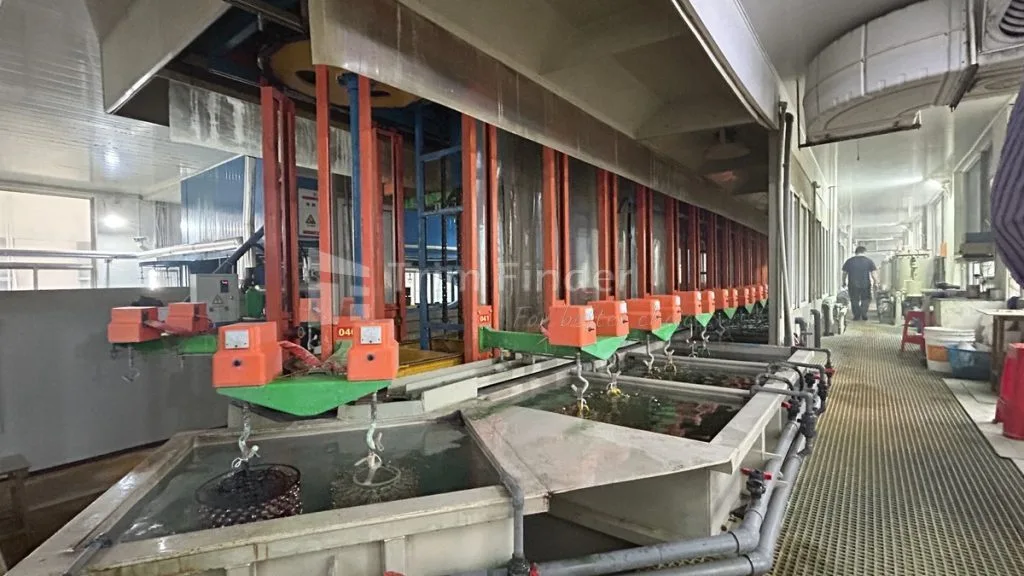
• Wastewater and heavy-metal handling in plating operations
• Dyeing effluent control
• Air emissions and dust management
• Solid waste recycling and reuse
ISO 14001 certification builds trust with global brands that require green manufacturing.
3. Higg Index / ZDHC (Sustainability & Clean Manufacturing)
Additional frameworks increasingly requested by global brands:
• Higg Index: developed by the Sustainable Apparel Coalition (SAC) to assess environmental performance across supply chains.
• ZDHC: “Zero Discharge of Hazardous Chemicals,” requiring chemical management against MRSL (Manufacturing Restricted Substances List).
Trend:
More brands are embedding Higg and ZDHC requirements in sourcing criteria, pushing zipper suppliers toward chemical transparency and end-to-end traceability.
III. Supply-Chain Value of Sustainability Compliance
| Value Dimension | How It Shows Up | Brand Benefit |
| Compliance | Meets international regulations (OEKO‑TEX, REACH, RoHS) | Smoother export; lower return risk |
| Quality consistency | ISO systems ensure stable production | Higher customer confidence |
| Sustainable image | Eco certifications + carbon reduction management | Stronger CSR and brand reputation |
| Cost control | Green manufacturing reduces scrap and energy use | Lower long-term operating cost |
4. Supply Chain and Manufacturing Capability: How to Evaluate a Zipper Supplier
4.1 Capacity and Delivery Capability
Reliable lead time is critical. As a midstream component, zipper delays can halt entire production lines. Evaluate four aspects: automation level, planning & scheduling capability, delivery reliability, and flexibility for mixed/small-batch orders.
I. Automation Ratio
Automation is a primary indicator of efficiency and consistency. Key processes—tape weaving, forming, polishing, plating, assembly, inspection—benefit significantly from automation.
| Process | Automation Equipment Examples | Benefit |
| Tape weaving | Automatic warping; constant-tension weaving | Uniform tape density; fewer breaks |
| Forming | Automatic injection molding; continuous element attachment | Accurate pitch; reduced variation |
| Plating | Smart plating lines; in-line monitoring | Uniform coating; reduced oxidation |
| Assembly | Automatic chain insertion; automatic slider mounting | Less human error; higher throughput |
| Inspection | CCD visual inspection; automatic sliding-force testers | Better outgoing consistency |
Evaluation suggestion: strong suppliers often have ≥70% automation and the capability to modify and maintain equipment in-house.
II. Delivery Reliability
Delivery reliability reflects production planning (PPC) and supply coordination. Brands value “on-time every time,” not just the fastest promise.
Audit points:
• Use of MRP/ERP systems.
• Standard capacity loading analysis and delivery risk evaluation.
• Ability to provide OTD (On-Time Delivery) metrics.
• Ability to re-schedule quickly when customer priorities change.
Reference: OTD ≥95%, and in peak seasons lead-time deviation within ±3 days where feasible.
III. Production Flexibility
Flexibility supports fast-response and multi-SKU, small-batch orders without compromising quality.
Indicators:
• Response time for small-batch customization (500–1,000 pcs): ≤7 days.
• Capability to run mixed colors, sizes, and styles flexibly.
• Rapid mold change and sampling capability.
• Dedicated sample lines and small-batch validation processes.
Many tier-1 suppliers build “flexible cells” to switch among coil/molded/metal series quickly.
IV. Capacity Buffer and Contingency
Key elements:
• Maintain 10–15% safe capacity buffer for peaks.
• Multi-site collaboration (main plant + satellite plants).
• Emergency raw material stock and cross-line support.
Advanced suppliers maintain backup capacity lines or qualified partner plants to mitigate disruptions (power limits, compliance campaigns, logistics breaks).
4.2 Materials and Sourcing System
Stable output depends on a reliable materials system. Suppliers should demonstrate material control, traceability, and inventory discipline.
I. In-house vs. Outsourcing Ratio
Higher in-house ratios generally mean stronger process control and better batch consistency, while high outsourcing can create traceability and quality risks.
Benchmark:
• Tier-1 brands (e.g., YKK, SBS) can reach 85–90% in-house.
• Strong tier-2 suppliers often maintain 60–70% in-house; outsourced steps must be validated and contract-managed.
Audit points:
• In-house coverage of weaving, dyeing, molding, plating, and assembly.
• Outsourced partners certified to equivalent standards (ISO 9001 / OEKO‑TEX where relevant).
• IQC and batch tracking for incoming outsourced parts.
II. Material Traceability
Zipper manufacturing uses many materials: monofilament, brass, POM pellets, dyes, plating chemicals, inks, etc. A robust supplier should trace each zipper to material lots and upstream suppliers.
Key control points:
• Material lot codes recorded in ERP.
• IQC incoming inspection records (incl. test reports).
• Lot numbers bound throughout production and packing.
• Traceability to supplier, receipt date, and inspection results.
Benefit:
When issues occur, root cause can be isolated quickly (material, process, or supplier), reducing recall risk and handling cost.
III. Inventory Management
Inventory discipline directly influences lead-time reliability and cash efficiency. Strong suppliers often combine JIT (Just-In-Time) with safety stock.
Typical practices:
• Raw material safety stock: 7–15 days for standard items (tape yarn, sliders, chains).
• Buffer stock for special custom parts (plating colors, specialty tapes).
• Barcode/RFID tracking for semi-finished and finished goods; real-time cycle counts.
• Optional VMI/consignment stock for key customers.
Key benchmarks:
| Metric | Best-in-class Reference |
| Raw material turns | ≥8 times/year |
| Safety stock coverage | Key materials ≥7 days |
| Inventory accuracy | ≥98% |
| On-time shipment rate | ≥95% |
IV. Supply Chain Integration Capability
Strong suppliers integrate upstream and downstream:
• Strategic contracts with material suppliers.
• Shared data across material–manufacturing–customer.
• In-house logistics capability or robust transport network.
• Risk management mechanisms for material volatility and lead-time exceptions.
A mature supplier may operate an SCM risk management system that can warn about schedule risks, balance capacity automatically, and respond quickly to demand swings.
4.3 Quality Control System (IQC / IPQC / FQC / OQC)
High zipper quality comes from a system that is prevention-first, process-controlled, result-verified, and continuously improved. A recommended approach is an ISO 9001 / IATF-style process framework with four-stage inspection, supported by SPC, MSA, and AQL sampling.
A. IQC — Incoming Quality Control
Goal: stop defects at the source and ensure materials meet specifications and compliance requirements.
Materials covered: monofilament/yarn, brass strips/wires, POM pellets, dyes/chemicals, plating chemicals, zinc-alloy slider parts, stops, waterproof films, etc.
Typical checks:
• Physical/spec: linear density, tensile strength, moisture; Cu/Zn ratio; POM MFI.
• Appearance/dimension: fuzz, thickness, color difference; burrs and dimensions of zinc parts.
• Functional: film peel strength; tape colorfastness (≥ Grade 4); plating bath density/pH.
• Compliance: verify OEKO‑TEX/REACH/RoHS/ZDHC MRSL documents and perform spot checks.
Disposition:
Use AQL (General II) and stricter levels for critical items. Nonconforming lots: quarantine → 8D CAPA → supplier re-validation → release/return decision.
B. IPQC — In-Process Quality Control
Goal: reduce variation at the process level and prevent batch-level escapes.
Key processes & controls:
Tape weaving/dyeing
• Parameters: ends/picks density, tape width/thickness, moisture regain, color ΔE, colorfastness.
• SPC: X-bar/R charts; Cpk ≥ 1.33.
Forming (coil winding / injection molding / metal element attachment)
• Parameters: pitch tolerance, element height/angle, coil spacing consistency, burrs.
• Equipment: real-time temperature/pressure/mold temp logs; CCD vision rejection for missing teeth.
Finishing (polishing / plating / coating)
• Parameters: coating thickness, adhesion (cross-hatch/tape), appearance grade, salt-spray pre-check.
• Chemistry: on-line records and correction for pH, ion concentration, conductivity.
Assembly & pre-run
• Parameters: slider–chain clearance, lock holding force, start pull force (N), smoothness grade.
• Mistake-proofing: Poka‑Yoke and barcode matching for slider type vs. chain profile.
Inspection rhythm:
First-article 100% check → hourly/bi-hourly patrol checks → re-first-article after mold/material changes.
Change control:
Tooling, formulations, or key parameter changes require ECN review and re-approval (e.g., PPAP).
C. FQC — Final Quality Control
Goal: systematic batch release validation for function, reliability, and appearance.
Typical items (AQL sampling):
• Function: smoothness and cycling (e.g., 500 cycles without abnormality); lock holding force (apparel ≥1.5 kgf / bags ≥3 kgf); pull-tab tensile.
• Dimensions: overall length, effective engagement length, stop positions, symmetry.
• Reliability: random sample tests for tensile, washing, thermal cycling, salt spray.
• Appearance: uniform plating; no pinholes/exposed base; clean tape and consistent color; chain straightness.
Rules:
Critical defects (CR): zero tolerance; major/minor per agreed AQL.
Documents:
Batch CoC, test reports, and traceability codes bound to shipping documents.
D. OQC — Outgoing Quality Control
Goal: final customer-view check for spec/label/quantity/packaging and shipment robustness.
Checks:
• Part number, color, length, chain profile, slider type, barcode match.
• Packaging: moisture protection, compression resistance, clear labels, traceable QR/RFID.
• Transport simulation: drop/vibration/high humidity pre-checks to avoid damage and corrosion.
• Shipping documents: inspection report, compliance declarations, traceability codes, packing list.
KPI examples:
OTD ≥95%; customer return PPM trending down; complaint closure cycle ≤10 days (incl. 8D).
E. Closed-Loop Improvement (CAPA / 8D)
Data loop:
Defect taxonomy (slippage/broken teeth/jamming/discoloration...) → Pareto → DOE on key factors.
System loop:
Monthly QRQC meetings; quarterly supplier scorecards; annual process capability review.
Tools:
FMEA updates, dynamic control plan maintenance, layered audits.
4.4 Technology and R&D Capability (Tooling, Special Processes, Rapid Customization)
For high-end suppliers, R&D is the moat—shown in tooling development, functional process platforms, and rapid sampling/customization services.
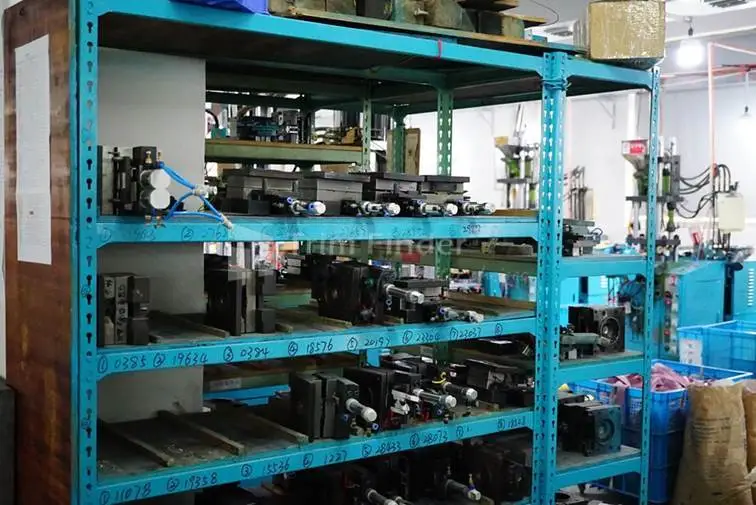
A. Mold Development
Scope: molded element tools, metal element tools, zinc-alloy slider die-casting tools, stop tools, fixtures and gauges.
Capability highlights:
• DFM review: element engagement angles/chamfers, slider cavity matching, core-pull and gate design, sink prevention.
• Precision: cavity tolerance ±0.01–0.02 mm; controlled cumulative pitch deviation; cavity surface Ra ≤0.4 μm.
• Equipment: high-speed CNC, wire EDM, mirror EDM, CMM/vision measurement.
• Tool life & maintenance: e.g., ≥500k shots; standardized spare parts and preventive maintenance.
• Validation: T0/T1/T2 trials → small-batch verification → PPAP mass-production release.
B. Functional Zipper Process Platforms
Water-resistant / waterproof
• Solutions: reverse coil + PU/TPU laminated tape; or coated chain + seam sealing.
• Keys: film thickness and adhesion, water-resistant slider design, sealing consistency; validate via hydrostatic head/rain tests.
Flame-retardant
• Solutions: FR tapes (aramid/FR polyester), FR resin formulations, low-smoke halogen-free systems.
• Standards: define metrics per application (e.g., EN ISO 14116, NFPA-related), including afterflame/afterglow and char length.
Corrosion resistant / low-reflective (marine, tactical)
• Solutions: matte black nickel/gunmetal plating; high salt-spray coatings (≥96–240h); resin replacing metal where possible.
Low-temperature flex / low noise
• Solutions: toughness-enhanced formulations; polished elements and lubrication coatings to reduce engagement noise.
Sustainable materials
• Solutions: recycled rPET tapes, bio-based nylon, dope-dyed formulations to reduce water use; provide LCA and recycling evidence.
C. Rapid Prototyping & Customization
Typical NPI/APQP flow:
RFQ → DFM/material confirmation → color card & slider option → T-sample → pre-production sample → pilot validation → mass production.
Example SLAs:
• Standard colors + standard slider: sample in 48–72 hours.
• New dye/lamination/plating color approvals: 3–5 days.
• New slider shape: 3D design + print 2–3 days; soft tooling 7–10 days.
Key capabilities:
• Color management: spectrophotometer ΔE control; Pantone/brand colors; sample dye line matching production curve.
• Digital customization: 3D modeling, custom logo engraving, QR traceability; MOQ-friendly (e.g., 300–500 pcs).
• Verification tools: sewing simulation with customer materials (including seam sealing and corners).
• Change control: FAI reports, issue list + 8D closure, BOM/formula freezing with version control.
D. R&D Management and Knowledge Base
Knowledge systems:
PLM libraries for element profiles and locking mechanisms; process/formulation databases; failure case libraries.
Test platforms:
Cycle-life testers, salt spray chambers, thermal shock, rain/hydrostatic tests, low-temp flex, peel/tensile rigs.
Collaboration:
Customer joint development programs and quarterly roadmaps (lighter, quieter, higher corrosion resistance, PFAS-free).
5. Communication and Service Capability: Supplier Soft Power
5.1 Responsiveness and Professional Support
1. Why responsiveness matters
As a midstream trim, any delay in quoting, sampling, confirmation, or delivery can derail an apparel/bag production plan. Strong suppliers maintain fast and professional feedback across quoting, sampling, mass production, and issue handling.
Key benchmarks:
| Item | Best-in-class Standard | Notes |
| Quotation reply | ≤24 hours | Includes feasibility review and preliminary lead-time |
| Sample lead time | Standard items within 72 hours | Includes slider finish and chain configuration confirmation |
| Technical response | ≤12 hours | Feedback on drawings, process, and risks |
| Issue handling | Initial response within 2 hours; solution within 24 hours | Close the loop on IQC/OQC issues |
2. Professional support structure
High-end zipper factories often operate a dual-line support model: PM + FAE.
• PM (Project Manager): order progress, lead-time coordination, cross-department communication.
• FAE (Field Application Engineer): on-site technical guidance, customer assembly validation, failure analysis.
3. Tools and collaboration mechanisms
Recommended practices:
• A unified customer communication portal (ERP/customer portal).
• Monthly production reports and WIP tracking.
• Dedicated account owner for key customers and weekly sync meetings.
5.2 Sampling and Engineering Support
1. Sampling capability reflects flexibility and R&D collaboration
Sampling speed and consistency are a strong window into a supplier’s technical capability. A robust supplier should have a dedicated sample center with dyeing, laser marking, rapid molding, micro-plating, color matching, and assembly.
Typical sampling lead times:
| Type | Lead Time | Notes |
| Standard color coil/molded zipper | 48–72 hours | Standard slider + existing color line |
| New plating color metal zipper | 3–5 days | Requires plating trial validation |
| New slider structure/shape | 5–7 days | Includes 3D print and soft-tool sample |
| Custom logo slider | 7–10 days | Includes design confirmation and tooling |
2. Engineering support
Great suppliers don’t just ship products—they provide engineering guidance:
• Design phase: recommend tooth profile, tape thickness, and locking type based on use case.
• Material phase: share comparative performance data for nylon/POM/brass.
• Pattern/sewing phase: advise seam allowance, corner radius, and anti-jam details.
• Validation: co-develop test plans for cycling, salt spray, wash, cold resistance, etc.
3. Joint sample review mechanism
Best practices:
• Provide physical samples plus video demonstration of operation before shipment.
• Use a sample approval form (color, structure, test results).
• Freeze a “Master Sample” after approval for reference and traceability.
5.3 After-Sales and Continuous Improvement
1. After-sales response mechanism
A strong after-sales system follows: fast response + traceability + closed-loop improvement.
When customers report issues (slippage, jamming, color difference, broken teeth), the supplier should initiate:
• 2-hour confirmation of issue and lot.
• Temporary action: stop shipment or quarantine suspect lots.
• Root cause: preliminary 8D within 48 hours.
• Permanent corrective action: update FMEA/control plan and train operators.
2. Data sharing and improvement meetings
• Monthly trends for customer returns/defects (PPM charts).
• Quarterly QBR (Quality Business Review) meetings.
• A tracked continuous improvement list with verified effectiveness.
3. Service KPIs and customer satisfaction management
A quantitative KPI system helps manage service quality:
| Metric | Target | Notes |
| Complaint closure rate | ≥98% | All issues must be closed-loop |
| Complaint response time | ≤24 hours | 2-hour initial response; 24-hour plan |
| On-time delivery rate | ≥95% | Includes special orders |
| Customer satisfaction | ≥90/100 | Regular survey or review |
4. Continuous improvement culture
• Monthly quality reviews with PDCA and 8D learning.
• Lessons-learned database for major complaints.
• Internal Kaizen system with incentives tied to measurable improvement.
• Joint improvement programs (JIP) with key customers to reduce defect rates.
6. Practical Supplier Selection Process
6.1 Initial Screening (Samples and Pricing)
The goal of initial screening is to identify candidate suppliers that meet minimum quality thresholds, offer competitive total value, and collaborate professionally. Evaluate four dimensions: sample performance, quotation structure, technical documentation completeness, and communication professionalism.
I. Sample Evaluation
Samples are the most direct representation of a factory’s process and QC maturity. Typical evaluation items:
| Check Item | What to Evaluate | Pass Criteria (Reference) |
| Appearance | Color consistency, gloss, chain straightness, clean/unwrinkled tape | Grade A appearance; no obvious defects |
| Smoothness & locking | Smooth pull, vibration, auto-lock effectiveness | Start pull ≤2 N; lock holding ≥1.5 kgf |
| Chain strength | Engagement strength; tooth break rate | No broken teeth in 10 checks; tensile ≥150 N |
| Colorfastness | Rub, wash, perspiration | ≥ Grade 4 (ISO 105) |
| Plating/coating | Thickness, adhesion, anti-rust | Salt spray ≥48h; 100% cross-hatch adhesion |
| Compatibility | Fit with target fabric and slider style | Matched chain/slider; no jamming |
Evaluation approach:
• Request at least three representative sample sets (different types/sizes).
• Test jointly by engineering and quality teams.
• Perform comparative testing versus current supplier when needed.
Application:
• Score ≥85: shortlist candidate supplier.
• Score <80 but with lead-time/cost strengths: request a second sampling round for validation.
II. Quotation Review
Price should not be compared by “lowest unit price” alone. Analyze cost logic and stability and assess value vs. risk.
Key dimensions:
| Dimension | What It Covers | Notes |
| Pricing structure | Unit cost breakdown (materials, plating, labor, scrap) | Is it transparent and reasonable? |
| Tiered pricing | Price gap between mass orders and small batches | Order flexibility |
| Lead-time impact | Whether rush fees are included | Emergency response capability |
| Payment terms | Credit terms, deposit ratio | Cashflow risk control |
| Tax & logistics | VAT, freight, duties | Consistent comparison baseline |
| FX risk | Currency for export pricing | Impact of exchange-rate swings |
Common traps:
• Extremely low pricing oftenoften implies material downgrades or thinner plating.
• “Introductory low price” followed by repeated increases due to “material cost hikes.”
• Excellent sample quality but unstable mass production.
Recommended practices:
• Request a BOM-style cost breakdown.
• Cross-validate pricing vs. origin, material, and process requirements.
• Use a cost reasonableness model to judge plausibility.
III. Technical Documents and Compliance Files
Document completeness is a strong indicator of professionalism. Request:
• Company profile (licenses, addresses, headcount, equipment list)
• Certifications (ISO 9001 / ISO 14001 / OEKO‑TEX)
• Test reports (tensile, salt spray, colorfastness, etc.)
• Compliance statements (REACH, RoHS, ZDHC MRSL)
• Customer references and brand cases
• Sample lot IDs and inspection records
Strong suppliers provide fast, well-formatted documents, ideally from third-party labs (e.g., SGS, ITS, BV).
6.2 Factory Audit (On-site or Remote)
After initial screening, conduct a factory audit to confirm real production capability, QC execution, and management discipline. Whether on-site or remote, the principle is systematic evaluation and traceability.
I. Audit Mode Selection
| Audit Mode | Applicable Scenarios | Characteristics |
| On-site audit | New supplier onboarding, strategic supplier, critical functional products | Full visibility of现场 and culture |
| Remote audit | Long distance, travel restrictions, re-audit | Video tour of lines and labs; recorded for traceability |
Remote audit requirements:
• Provide an audit checklist and camera route in advance.
• Use high-definition video to show key processes, inspection records, warehouses, and certificates.
• Record the audit session for transparency.
II. Key Audit Modules
1) Production floor management
• Line layout and separation of people/material flow
• Equipment maintenance plans and check logs
• Control of key parameters (temperature, pressure, bath concentration, tension)
• Clear visual management (OK/NG/quarantine)
2) Quality control system
• Execution of IQC/IPQC/FQC/OQC
• Record completeness (sampling sheets, patrol sheets, SPC charts)
• Issue handling and 8D process
• Calibration logs and traceability IDs
3) Lab and testing capability
• In-house lab availability
• Equipment: tensile tester, wash tester, salt spray chamber, colorimeter, constant climate chamber, etc.
• Ability to provide third-party equivalent testing
• Standard manuals (ASTM, ISO, GB/T)
4) Materials and warehousing
• Segregation and FIFO discipline
• Hazardous chemical storage control
• Barcode/RFID tracking
• Temperature/humidity logs and safety-stock days
5) Environment and safety
• Wastewater/air treatment logs for plating
• Safety signage and firefighting readiness
• PPE and training records
6) Management and culture
• Leadership involvement in quality
• Employee turnover and skill levels
• Training and improvement activities (5S/Kaizen)
III. Audit Scoring and Grading
After the audit, score each module quantitatively:
| Module | Weight | Best-in-class Standard | Disqualifying Trigger |
| Equipment & processes | 25% | Automation ≥70%; key processes in-house | Outsourced key processes without validation |
| Quality control system | 25% | Complete records; FQC pass rate ≥98% | No test equipment or falsified records |
| Management & safety | 15% | Environmental compliance; safety drill records | No wastewater/air treatment facilities |
| Lab & testing capability | 15% | Can complete full test suite in-house | No capability and fully outsourced |
| Floor management & 5S | 10% | Clean zones and clear labeling | Mixed materials; no traceability IDs |
| Documents & compliance | 10% | Certificates complete and up to date | No ISO/OEKO certificate |
Rating:
• A (≥90): preferred strategic supplier
• B (80–89): qualified for onboarding
• C (70–79): re-audit after corrective actions
• D (<70): eliminate from approved list
IV. Conclusions and Follow-up
Issue a formal audit report including:
• Findings list
• Risk level and corrective deadlines
• Follow-up plan
• Next audit timing
Strong suppliers submit corrective action reports (CAR) within 7 days and close verification within 30 days.
6.3 Pilot Run / Line Trial
Goal: run a small batch using real production lines, real materials, and real processes to confirm that sample quality can be consistently reproduced in mass production—and to make a Go/No-Go decision with data.
I. Scale and coverage
Recommended batch size: 1,000–5,000 pcs per size, covering core and high-risk variants.
Coverage dimensions:
• Type: coil/molded/metal
• Size: #3/#5/#8/#10
• Color: dark/light/plating colors
• Slider type: auto-lock/semi-lock/non-lock
Same-condition reproduction:
Use the same equipment, tooling, formulations, fixtures, and gauges as mass production; do not substitute with an “experimental line.”
II. Inputs (completeness checklist)
• Drawings/BOM: version-controlled with dates; includes tooth parameters, coating requirements, tape density, dye curves.
• Control plan (CP) and SOP: key parameters and mistake-proof points.
• Gauges: calibrated and consistent measurement methods.
• Incoming release: IQC pass + compliance docs (OEKO/REACH/RoHS).
• Tooling status: validated (T1/PPAP state) with life and maintenance records.
III. Execution and online QC
Key process parameters and controls:
| Process | Key Parameters | Online Control / Records | Failure-Mode Prevention |
| Tape weaving/dyeing | Width/thickness, color ΔE, moisture regain | X-bar/R charts; Cpk ≥ 1.33 | Edge wrinkling → closed-loop tension control |
| Forming (winding/molding/attachment) | Pitch, tooth height, coil spacing consistency, burrs | 100% CCD + sampled manual check | Mis/missing teeth → automatic rejection |
| Finishing (polish/plating/coat) | Thickness, adhesion, salt-spray pre-check | Online concentration/pH/temperature | Discoloration/rust → bath SPC |
| Assembly & pre-run | Lock force, start pull, smoothness grade | 100% functional conveyor test | Slippage/jam → wrong-match Poka‑Yoke |
Sampling and AQL:
• Critical functional characteristics: AQL 0.65 (or per brand standard)
• Appearance/general dimensions: AQL 1.0–1.5
• First-article +patrol checks: first-article 100%; patrol checks every 1–2 hours; restart first-article after tool/color changes.
IV. Functional and reliability validation (pilot batch)
• Cycle life: ≥500–1,000 cycles (≥2,000 for outdoor/bags); functional retention ≥98%.
• Lock holding force: apparel ≥1.5 kgf; bags ≥3 kgf; no creeping open.
• Pull-tab tensile: ≥150–300 N (by spec/use).
• Salt spray pre-check: 48–96h with no red rust or blistering.
• Washing/dry cleaning: after 20 cycles, smoothness stable; colorfastness ≥ Grade 4.
• Thermal cycling: −30°C to +70°C for 10 cycles without cracking or jamming.
V. Process capability and consistency
• Cpk for key characteristics (pitch, tape width, start pull, lock force): ≥1.33 (≥1.67 for core SKUs preferred).
• Yield and defect structure: first-pass yield ≥98%; Pareto analysis for Top 3 defects.
• DPPM/PPM target: ≤1,500 PPM (tighten per customer grade).
• Batch consistency: variation among shifts/equipment/time windows <10%.
VI. Outputs and Go/No-Go decision
Deliverables:
FAI report, SPC charts, inspection records, reliability test report, failure analysis + CAPA (8D), and traceability list.
Decision:
• Go: allcriteria met; critical Cpk qualified; defects under control.
• Conditional Go: minor deviations with clear corrective plan and timeline.
• No-Go: functional/safety items fail or systemic loss of control.
Freeze: approved BOM/process parameters/gauges/appearance master samples; subsequent changes require ECN/PPAP re-approval.
VII. Customer-side fit and assembly validation
• Sewing trials with customer fabrics/plackets/zipper channels, including corners and seam sealing.
• User-simulation tests: gloved handling, night operation, low-temperature flex.
• Record “symptom → cause → action → re-test” as addendum to mass-production process cards.
6.4 Long-Term Cooperation and Quality Agreement
Goal: convert pilot-proven results into enforceable contract terms, quality rules, data mechanisms, and risk contingency—forming an executable, auditable, and enforceable partnership framework.
I. Commercial Framework
Recommended clauses:
• Pricing and tiers: annual volume targets; tiered pricing; price changes require material/FX evidence and notice period.
• Lead-time SLA: standard lead times (e.g., 7–10 days standard; 15–20 days custom); OTD ≥95%; rush-order TAT.
• MOQ and flexibility: fast-line clauses for small batches (e.g., 300–500 pcs per color/size).
• VMI/consignment: 2–4 weeks safety stock for core SKUs with reconciliation.
• Settlement & FX: currency, payment terms, FX adjustment mechanism.
• Confidentiality & IP: custom sliders, tooth profiles, formulas, colors are customer-owned; no external display/sales.
• Audit rights: customer process audits and third-party spot testing.
• Force majeure / BCP: multi-site switching, backup tools, safety capacity, and shortage penalties.
II. Quality Agreement
Clarify “how quality is defined” and “how issues are handled” to avoid disputes.
1) Specs and standards
• Technical specification: pitch/tooth geometry/tape width/start pull/lock force/salt spray/colorfastness, etc.
• Master samples: sealed master and color panels; changes require双方 signature.
• Inspection rules: AQL levels, sampling plans, 100% functional conveyor for critical characteristics.
2) Incoming and process control
• IQC documents: items/frequency/criteria; compliance document update cycles.
• Process control: SPC characteristics, Cpk targets, patrol frequency, re-first-article after changeovers.
• Traceability: lot code rules (date/shift/machine/formula/bath No.) traceable back to incoming materials.
3) Reliability and type testing
• Annual re-validation: full suite including cycling, salt spray, thermal cycles, wash durability.
• Customer audit testing rights: quarterly/biannual random re-tests.
4) Change management (ECR/ECN/PPAP)
Triggers: material change, formula change, tool/equipment change, parameter change, outsourcing substitution.
Notice: ≥30 days; re-approval via PPAP package before implementation.
5) Nonconformance and claims
• Responsibility rules based on traceability/test records.
• Stop/recall rights for major functional defects.
• Cost sharing: returns, rework, logistics, line-stoppage caps and calculation method.
• Service timing: 2-hour response, 24-hour corrective action, 7-day 8D closure.
6) KPIs and continuous improvement
• KPIs: OTD ≥95%; PPM decreases quarterly (e.g., ≤1000 → 800 → 600); complaint closure ≤10 days.
• Quarterly QBR and joint improvement program milestones.
7) Compliance and sustainability
• Continuous compliance with OEKO‑TEX/REACH/RoHS/ZDHC MRSL and spot testing rights.
• Social compliance audits when needed (BSCI/SMETA).
• Data/privacy and retention policies.
III. Ramp Plan and Supplier Nomination
Phased ramp:
Start with 20–30% share of core SKUs; reach 50–70% within 3–6 months as performance proves out; increase B/C categories gradually.
Dual sourcing:
Keep at least one backup supplier for critical SKUs, maintained via annual pilot validation.
Exit mechanism:
Two consecutive quarters of KPI failure ormajor breaches triggers exit and switch to backup.
IV. First 90 Days Stabilization (“Escort”) Mechanism
• Weekly syncs: progress + daily/weekly quality tracking.
• R/Y/G alerts for delivery/quality/cost.
• On-site FAE support during first mass-production week at customer sewing/assembly lines.
• Issue log: one item per list (issue–owner–action–deadline–retest).
7. Conclusion: A High-Quality Zipper Is the Hidden Business Card of Product Value
I. Why zipper selection matters
A zipper is small, but it is often the detail that reveals the biggest quality gap. A smooth, strong, visually coordinated zipper not only defines use experience—it reflects a brand’s respect for craftsmanship and the consumer.
From a supply chain perspective, a zipper is a structural component rather than a disposable trim. Its stability affects:
• Function: slippage, broken teeth, jamming, and discoloration can trigger lot returns.
• Brand: zipper failure is highly visible to end users and damages credibility.
• Economics: a small zipper issue can cause rework, compensation, and delivery delays far exceeding unit cost differences.
• Sustainability: premium zippers extend product life and reduce waste.
Choosing a supplier with robust QC systems, compliance discipline, fast response, and continuous improvement is an investment in supply chain resilience and long-term competitiveness.
II. Building a long-term, transparent partnership
Great brands don’t just “pick” suppliers—they co-develop and grow with partners. An ideal cooperation model includes:
Two-way transparency
• Share forecasts, plans, and inventory information.
• Communicate issues and corrective actions in real time.
• Clear boundaries and data-based trust.
Collaborative innovation
• Jointly develop new materials and processes (waterproof, flame-retardant, sustainable).
• Optimize zipper–product design fit and improve manufacturability.
• Build a unique “zipper design language” that supports brand evolution.
Shared growth
• Annual QBR goals for quality, lead time, and sustainability.
• Brand-side technical training and improvement incentives.
• Supplier feedback on process innovations and trends—creating a learning loop.
Sustainability commitment
• Joint compliance with OEKO‑TEX, ZDHC, and social responsibility requirements.
• Promote recycled materials, low-carbon manufacturing, and circular strategies.
• Strengthen global influence through green supply chains.
III. Closing
A high-quality zipper is more than a component—it is the product’s hidden business card.
It is present in every smooth pull, every quiet engagement, and every small metallic sheen, reflecting a brand’s commitment to quality, respect for craftsmanship, and responsibility for user experience.
In global manufacturing competition, those who respect details, value collaboration, and practice long-termism will build truly trusted brands—even in a “small” field like trims.
A good zipper is a brand’s silent spokesperson.
It says nothing—yet every opening and closing becomes a quiet proof of quality.